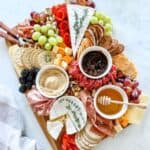
Gluten Free Charcuterie Board
Charcuterie boards are everywhere in all shapes and forms and for every event. I have put together a gluten free charcuterie board with the best of a cheese board and charcuterie board to make one large gluten free party platter. Step by step process of what food to use to how to arrange a charcuterie board.
Servings: 16 Servings
Equipment
- Board, serving platter or tray
- Sharp cheese knife's
- Small spoons for chutneys
- Honey wand optional if serving honey
- Toothpicks
- Small serving plates
- Napkins
Ingredients
Ingredients for a gluten free charcuterie board
Meat - Choose 3-5 for a party platter
- Salami
- Prosciutto
- Sliced cooked Ham
- Italian Sausage
- Pepperoni
Cheeses - Choose 3-5 for a party platter
- Brie
- Camembert
- Cheddar
- Gouda
- Parmesan
- Gruyere
- Feta
- Goats cheese
Gluten free crackers - Choose 3-5 for a party platter
- Crunchmaster gluten free crackers
- Schar gluten free crackers
- Snack Organisation Rice crackers
- Nairn's gluten free crackers
- Nairn's gluten free oat cakes
- Good Thins gluten free Rice crackers
- Gluten free Flatbreads
- Toasted gluten free breads
Extras - Choose 3-5 for a party platter
- Nuts
- Fresh Fruit - grapes, strawberries, blackberries, raspberries, figs, olives, and any seasonal fruit.
- Dried fruit - raisins, cherries, apricots, cranberries, or mixed dried fruit selection.
- Vegetables - sliced or cubed cucumber, carrots, bell peppers, celery sticks, or cherry tomatoes.
- Gluten free mini pretzels or gluten free bread sticks.
- Sauces and dips - olive oil, honey, hummus, jams, and chutneys.
Instructions
How to assemble a charcuterie board
Adding Cheese
- Slice any hard cheese before to make it easier to remove when eating.
- Start by placing the cheeses on the board. There are no set rules but I like to place cheese on each quarter of the board as I feel this creates balance in the board.
Adding the meat
- Add the meats to the board, again with the same concept of creating balance. This is more pleasing to the eye and makes all the food on the board accessible from all angles.
- When placing the meats I like to try and make it interesting by creating different shapes with the meat.
- Lay longer stripes of meat to create lines. Fold meats to create triangles. Bunch together thin slices of meat to create a fan effect. Roll the meat and stack them together to create height. My favorite is with small round meats like pepperoni sliced halfway into the circle and then rolling the meat from the cut edge into itself to make a small spiral-like appearance. Similar to a rose but much easier and takes little effort.
Dips and chutneys
- Then add any smaller dipping sauces or chutneys to the board. I like to place any meat around the dishes to create further interest.
- You can leave the dipping dishes to the side of the charcuterie board if preferred or if you feel they are a little large and take up a lot of board space.
Adding crackers
- Introduce the crackers and bread to the board. Again using the method of creating balance.
- Placing smaller crackers in spaces that are tighter and using larger crackers of slices of bread to create lines or fanned appearance.
- You will want to keep crackers on a separate plate if you are not creating a fully gluten free board to reduce the risk of cross-contamination.
Adding fruit, vegetables, and extra nibbles
- Add the chosen fruit, veg, or extras to the board ensuring that there is some at each angle of the board.
- I also like to think about color as well as balance when I get to this step. Placing darker fruit near lighter foods on the board and vice-verser.
- Is one side of the board noticeably lighter than the other and adding in a few extra dark berries or grapes balances the color of the board.
Completing the gluten free charcuterie board
- At this point, all the main elements are on the board. I then continue with the view of filling out any spaces with extra meat, cheese, nuts, and fruit using the balance and color theory to make it aesthetically pleasing.
Notes
- Mini Charcuterie board for two - choose 2 items from each section below to make a small charcuterie board perfect for date night or Valentine's treat.
- Gluten free platter for 4-6 - choose 3 items from each section below to make a medium-sized board perfect to serve as a charcuterie appetizer or game night nibbles.
- Party Charcuterie board - Choose anything from 3-5 items from each section below depending on how many people are attending the event to make a large charcuterie board.