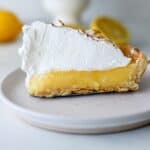
Gluten Free Lemon Meringue Pie
This Gluten Free Meringue Pie features a smooth, silky lemon filling topped with a light and airy Swiss meringue that is lightly toasted to perfection, all encased in a beautifully flaky gluten free pie crust.
Servings: 8 Servings
Calories: 566kcal
Ingredients
Gluten Free Pie Crust
- 1 Gluten free pie crust See my homemade pie crust linked in the post above.
Lemon Filling
- 5 large egg yolks
- 200 grams Superfine sugar I used caster sugar.
- 30 grams Cornstarch Also known as cornflour in the UK.
- ⅛ teaspoon Salt
- 1 tablespoon Lemon zest
- 180 mls Fresh lemon juice From 4-5 lemons
- 300 mls Water
- 60 grams Unsalted butter
Swiss Meringue Topping
- 5 large Egg whites room temperature
- 200 grams Sugar
- ½ teaspoon Vanilla extract
- ⅛ teaspoon Salt
Instructions
Gluten Free Pie Crust
- I recommend making the pie dough the day before and storing in the fridge to chill.
- Roll out the dough evenly until it is around a 12-inch circle. To make rolling the pie dough easier, I like to roll it out on parchment paper or Plastic wrap.
- Carefully transfer the dough without stretching it onto the pie dish. Gently press the dough into the bottom and sides of the dish.
- Trim any excess dough around the edges of the pie dish leaving around 1 inch around the edge of the dish. Fold and tuck the excess dough around the inner edge of the pie dish. This will make a neat, thicker crust around the edge of the pie that is easier to shape.
- Crimp the edge of the crust. The shape of the crimp is your own personal style or preference. I like to use my fingers by creating a small v shape around the edges but you can also use a crimping tool or a fork.
- Place the pie dish in the fridge to chill for 30 minutes.Preheat the oven to 220°C/425°F.
- After the dough has chilled, using a fork dock the base of the pie crust by pricking the bottom of the pie crust several times. This will allow steam to escape and help prevent it from puffing up and helps the bottom stay flat in the dish.
- Line the pie crust with parchment paper leaving some overlap over the sides of the pie dish. Gently fill it using ceramic baking beads, uncooked rice or beans. Be sure to get all the pie weights up to the edge of the crust.Bake in the oven for approx 15-20 minutes until the edges of the pie crust are starting to turn a light golden brown.
- Carefully remove the oven and remove the parchment paper with the pie weights.Reduce the oven temperature to 190°C/375°F.
- Return to the oven after removing the parchment paper for a further 15-20 minutes until the pie crust is a beautiful golden brown color.
- Remove from the oven and set the pan on a wire rack to cool completely.
How to Make the Lemon Filling
- Carefully separate the egg yolks and egg whites and set the egg whites aside (these will be used in the meringue topping)
- Juice and zest the lemons and set aside.
- Whisk the egg yolks and set aside.
- In a non-stick pan whisk the sugar, salt, and water until fully combined.
- Add the lemon juice, lemon zest, and water. Whisk until lump free.
- Place on medium heat and continue whisking until the mixture thickens and small bubbles start to form on the surface (approx 5 minutes).
- Remove from the heat and add a few tablespoons at a time of the warm mixture into the egg yolks to temper the eggs until you have added around 8 tablespoons of the hot lemon mixture.
- Slowly pour the tempered egg mixture into the lemon mixture, continually whisking until it is fully combined.
- Place over medium heat and whisk until it starts to bubble (approx 3 minutes).
- Remove the pan from the heat and whisk in the butter until melted and fully combined.
- Pour the lemon filling into the cooled pie crust and let it come to room temperature. Then place in the fridge to chill for at least 4 hours but preferably overnight to firm up.
How to Make Swiss Meringue
- Using a bain-marie with a pan of simmering shallow hot water with a larger glass bowl on top. (Do not bring the water to the boil or have the bowl submersed into the water).
- Add the sugar and egg whites to the glass bowl. Constantly whisk until the sugar has dissolved with the egg whites. You can test by carefully rubbing a little of the mixture between your fingers and it should feel smooth.You can also test by using a thermometer and it should reach 160°F (71°C). This temperature is sufficient to pasteurize the egg whites, making them safe to eat.
- In a stand mixer or hand-held electric whisk beat on high until the mixture forms stiff peaks (Usually 5-8 minutes) stopping throughout to scrape down the sides to ensure all the mixture is being incorporated.
- Once stiff peaks have formed whisk in the vanilla extract and salt.
- Gently add and smooth the meringue on top of the cooled lemon filling. Using an offset spatula. I like to make some swirls or soft peaks.
- Using a chef blowtorch, carefully toast the surface of the Swiss meringue.
- Cover and store in the fridge until serving. It is best served after the meringue topping has been added but will keep in the fridge for up to two days.
Notes
Tips:
- Tip #1: Rolling the pie dough on plastic wrap will prevent it from sticking, and there is no need for extra flour on your surface, which prevents the pastry from drying out. It also makes the dough easier to lift onto the pie dish by lifting up the plastic wrap and then flipping it over the pie dish.
- Tip #2: Trimming the parchment paper to have excess paper over the sides of the pie dish will make it easier when lifting the parchment paper. The pie weights will be hot, and you can lift them out using the excess paper.
- Tip #3: Be sure that no egg yolk has got into the egg whites when separating the eggs as this can result in the egg whites not whipping to stiff peaks. I like to also wipe any equipment such as the bowl and whisk with a little lemon juice to clean and remove any grease as this can also prevent the finished result.
- Tip #4: Adding the hot lemon mixture to the egg yolks slowly will temper the eggs, ensuring they don’t cook too quickly or curdle.
- Tip #5: Chilling the filling before adding the Swiss meringue topping will provide a firm stable base for the meringue topping.
- Tip #6: If you don't have a chef's blowtorch, using your oven's broiler on high, place the pie on the top rack and watch carefully for 1-3 minutes. I don’t recommend any longer than this, as the meringue can burn very quickly under direct heat, and the lemon pie filling may become too hot, causing the meringue to lose its texture or weep.
Nutrition
Serving: 1serving | Calories: 566kcal | Carbohydrates: 67.3g | Protein: 19.2g | Fat: 25.6g | Saturated Fat: 11.2g | Polyunsaturated Fat: 3g | Monounsaturated Fat: 7.3g | Cholesterol: 665.5mg | Sodium: 308.7mg | Potassium: 240.6mg | Fiber: 0.2g | Sugar: 52.9g