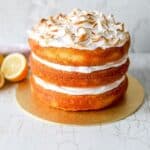
Lemon Meringue Cake
This Lemon Meringue Cake is just the perfect spring celebration cake. Soft fluffy lemon cake layers sandwiched together with zesty lemon curd and topped with a smooth pillowy toasted meringue frosting.
Servings: 12 Servings
Calories: 571kcal
Equipment
- 3 Round baking pans ( I used 8 inch pans)
- Stand mixer or electric beaters
- Bain-marie or medium-sized pan with a large glass bowl
- Parchment paper
- Rubber/silicone spatula
- Hand held whisk
Ingredients
Ingredients for Lemon Cake
- 400 grams Gluten free All Purpose Flour
- 400 grams Sugar
- 400 grams Unsalted Butter Room temperature
- 4½ teaspoons Baking Powder Be sure to check that the baking powder is gluten free as some brands contain gluten.
- 6 large Eggs Room Temperature
- 2 teaspoons Vanilla Extract
- ½ teaspoon Xanthan Gum You can omit if flour blend already contains xanthan gum
- ¼ teaspoon Salt
- 1 Fresh Unwaxed Lemon (for 1 tablespoon of Zest and 3 teaspoons of fresh lemon juice)
Ingredients for Lemon Curd (You can use store bought lemon curd if preferred)
- 200 grams Superfine Sugar (Such as caster sugar)
- 4 Large Egg yolks
- 4 fresh Unwaxed Lemons (Makes approx 3 tablespoons of zest and 150ml of lemon juice)
- ⅛ teaspoon Salt
- 100 grams Unsalted Butter
Ingredients for Meringue Frosting
- 4 large Egg Whites
- 200 grams Superfine Sugar
- ½ teaspoon Vanilla Extract
- ⅛ teaspoon Salt
Instructions
How to make the Lemon cakes
- Preheat the oven to 175°C/325°F/Gas mark-3. Prepare baking pans with parchment paper.
- In a large bowl or stand mixer mix all dry ingredients together.
- Add the eggs, butter, and vanilla extract and beat with the paddle attachment or hand-held electric beaters until fully combined, lump-free, and fluffy.
- Use a zester or a fine grater to gently remove the outer layer of zest from the lemon. Then roll the lemon on a countertop using the palm of your hand to soften it. Cut the lemon in half then using a citrus juicer squeeze and rotate to release the lemon juice.
- Add the lemon zest and 3 teaspoons of lemon juice to the cake batter and fold in gently until fully incorporated.
- Divide the cake batter evenly between the cake pans and spread it out evenly within the pan (I like to weigh each cake pan to ensure the batter is evenly divided).
- Place the cake pans in the pre-heated oven for 25-30 minutes until lighly golden on top. To check for doneness, insert a skewer into the center of the cake, and if it comes out clean, transfer the can pans to a cooling rack. (You can quickly check after 15 minutes without letting too much heat escape from the oven and If your oven has hot spots or uneven heating, consider rotating the cake pans halfway through the baking time).
- Leave to cool while you make the lemon curd and meringue frosting.
How to make Lemon Curd
- Carefully separate the egg yolks and whites into separate bowls ensuring that no yolk gets into the egg whites. Cover and set aside the egg whites for the frosting. Slice the butter into cubes and set aside.
- Make a bain-marie with a pan of simmering shallow hot water with a larger glass bowl on top. (Do not bring the water to the boil or have the bowl submersed into the water).
- Juice and zest the lemons and add them to a large glass bowl. Add in the egg yolks, sugar, and salt and whisk until fully combined.
- Gently stir constantly with the whisk or a spatula until the liquid starts to thicken (Usually takes approx 10 mins). To test the mixture it should coat the back of a spoon. Constantly stirring prevents the eggs from cooking.
- Once thickened remove the bowl from the heat add the cubed butter and stir in until it all has completely melted. The lemon curd will thicken further as it cools.
- When the butter has melted and is fully incorporated place a sieve over a bowl and carefully pour the lemon curd through the sieve into the bowl.
- Place plastic wrap directly on top of the curd mixture as this will help prevent skin from forming on top (See image 8 ). Once cool place in the refrigerator until ready to use.
How to Meringue Frosting
- Using a bain-marie with a pan of simmering shallow hot water with a larger glass bowl on top. (Do not bring the water to the boil or have the bowl submersed into the water).
- Add the sugar and egg whites to the glass bowl. Constantly whisk until the sugar has dissolved with the egg whites. You can test by carefully rubbing a little of the mixture between your fingers and it should feel smooth. You can also test by using a thermometer and it should reach 160°F (71°C). This temperature is sufficient to pasteurize the egg whites, making them safe to eat.
- In a stand mixer or hand-held electric whisk beat on high until the mixture forms stiff peaks (Usually 5-8 minutes) stopping throughout to scrape down the sides to ensure all the mixture is being incorporated. See image 12.
- Once stiff peaks have formed whisk in the vanilla extract and salt.
- The Meringue frosting is ready to use. If you are making the meringue frosting ahead then store it in an airtight container and place it in the refrigerator. let it come to room temperature and give it a quick whip to bring back its fluffy texture before assembling the cake.
Assembling the Cake
- If your cake has noticeable domes, you can use a serrated knife to level them, ensuring a flat top, though with these cakes, there's usually no substantial dome or minimal need for leveling.
- Position the first layer of lemon cake on your cake stand or serving plate, and evenly spread about a quarter of the meringue frosting layer making a thicker rim of frosting around the edge (This will help the filling stay in place). Spoon in few table spoons of lemon curd into the center and carefully spread out evenly (See image 13).
- Repeat the cake layer process and then top with the final top cake layer. Place the remaining frosting on top. Spread the frosting carefully over the top of the cake creating peaks.
- Using a chefs blow torch carefully and evenly torch the peaks of the frosting. Hold the torch a few inches away from the peaks and move it in a circular motion to lightly toast them to your disired level of color.
Notes
PRO RECIPE TIPS
- Tip #1: Use good quality ingredients. I always use good quaility butter and vanilla extract. The best ingredients really shine through and make for a better end result.
- Tip #2: Be sure to use room-temperature ingredients for the cake batter. Not only will this make it easier to mix when using the all-in-one method but is essential for a light and airy mixture that traps air bubbles, helping the cake's rise and texture.
- Tip #3: Weighing each pan with the cake batter will help ensure that even amounts are distributed into each cake pan.
- Tip #4: Whisk the curd constantly while cooking to prevent it from curdling or sticking to the bottom. This also helps to ensure a smooth, silky texture.
- Tip #5: Placing the plastic wrap directly on top of the lemon curd as it cools will prevent skin from forming on top once it's cooled.
- Tip #6: Be sure that no egg yolk has got into the egg whites when separating the eggs as this can result in the egg whites not whipping to stiff peaks. I like to also wipe any equipment such as the bowl and whisk with a little lemon juice to clean and remove any grease as this can also prevent the finished result.
- Tip #7: Keep a close eye on the frosting peaks as you torch them to avoid burning the frosting too much. You want to achieve a golden-brown color and a slightly caramelized texture.
- Dairy Free - To make this lemon meringue cake dairy free you can use your preferred dairy free butter block.
- Store Bought Lemon Curd - Don't want to make homemade lemon curd you can use your preferred store bought in place.
- Different Flavors - Experiment with different flavors by switching out the lemon curd for your preferred filling such as raspberry, strawberry or lime curd.
- Fully Frosted Cake - If you want to fully frost the cake I recommend doubling the frosting ingredients. The method remains the same but will give you enough to cover the top and sides.
Nutrition
Serving: 1serving | Calories: 571kcal | Carbohydrates: 83.9g | Protein: 15.5g | Fat: 20.7g | Saturated Fat: 3.3g | Polyunsaturated Fat: 0.9g | Monounsaturated Fat: 1.4g | Cholesterol: 138.9mg | Sodium: 415.9mg | Potassium: 304.9mg | Fiber: 5.2g | Sugar: 51.5g